Thursday, January 12, 2017

Facing Our Anger

The English poet William Blake wrote a poem about the danger of allowing our anger to fester.  He called it “A Poison Tree”:

I was angry with my friend; 
I told my wrath, my wrath did end. 
I was angry with my foe: 
I told it not, my wrath did grow. 

And I waterd it in fears, 
Night & morning with my tears: 
And I sunned it with smiles, 
And with soft deceitful wiles. 

And it grew both day and night. 
Till it bore an apple bright. 
And my foe beheld it shine, 
And he knew that it was mine. 

And into my garden stole, 
When the night had veild the pole; 
In the morning glad I see; 
My foe outstretched beneath the tree.


In simple, child-like language, William Blake identifies the emotional fuel that keeps our anger going.  Fears, tears, smiles, wiles.  Our fear of this or that fuels our anger; our desapir fuels it; as time goes on we are happy to maintain it, it is comforting to be angry; we tell all sorts of stories to ourselves and others in order to keep it going.  And it grows and grows.  Until it is downright deadly.

I don’t have to give you a list of all of the conflicts we endure – in our families, in our community, in our nation, between nations – you can come up with plenty of examples.

Since anger is universal and so destructive, I think it’s worth giving thought to what fuels it and if its destructive nature is inevitable. 

Anger plays a significant role in the story of Joseph and his brothers, a magnificent mini-narrative within the larger Genesis saga.

Thursday, December 15, 2016

Remind Me Who I Am

It's important for us to remember who we are, as individuals and as a nation.  Not as simple as it sounds.  Gail Sheehy wrote a popular book called Passages in 1976 in which she outlined the challenges that people face at different stages of their lives.

I want to focus for a few moments on the 20’s.  Sheehy refers to the 20’s as the “trying 20’s” – I assume she intended the pun – the 20’s are a time in a person’s life for trying things out –relationships, professional paths – once people have gained some independence from their parents.  But the 20’s are also trying in the sense of difficult.

You look at people in their 20’s and they seem to be having an awesome time – they tend to look great, they are energetic, trying new things – big thumbs up – and in many respects they are having an awesome time.  But beneath the surface, there is often insecurity that comes form being “neither here nor there,” having left the structure of the home in which they grew up and not yet having settled into a home of their own creation.


It is really important for people at any stage in life to feel grounded – to feel connected to family and community – but it is especially important during this phase of a person's life.  Our three children are currently all in their 20's and I see how important it is first-hand.

In this phase of life a person needs to be reminded who he or she is fundamentally – what is the bedrock that I come from, and what is my potential.  The details – those can be worked out, even when painful – but the essential "who am I" needs to be conveyed by the people who care most. 

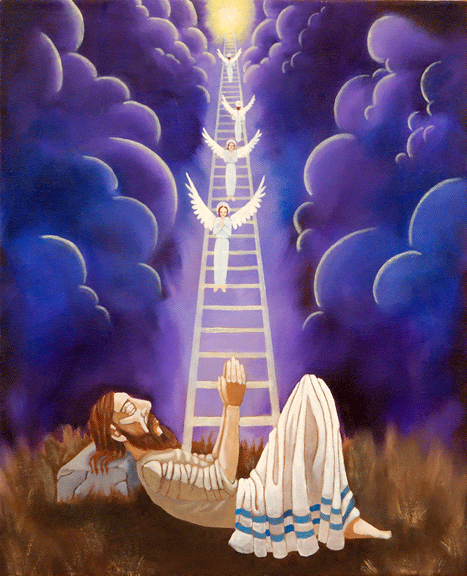
We don't know how old Jacob was when he left Beer Sheva on his way to Haran – escaping from his brother who wanted to kill him and heading off to find himself a spouse.

Who knows if he was actually in his 20's, but he was definitely in a trying phase of his life.  One has to imagine that he felt vulnerable all on his own, fearful of his brother's anger, possibly remorseful about his actions in the past, anxious of his prospects for the future.

Vayetze – he has left somewhere, but he surely hasn't arrived anywhere yet – and he won't settle for decades.

He is, emotionally, psychology, a representative of everyone who, at a certain point – is between the relative stability of the home we grew up in and the relative stability of the home we will establish.

If you've ever been in that place – you left home, maybe for university, maybe to seek out a professional opportunity, maybe to move a new land – and you have no idea where you will ultimately land – then you likely can relate to Jacob's situation.

Wednesday, December 7, 2016

Destiny Need Not Destroy Us

I’m currently watching an engaging series called “The Crown” on Neflix – about Queen Elizabeth II and the royal family.

Lots of intrigue as you might imagine – one source of intrigue is the relationship between Elizabeth and her sister Margaret.  As children, Elizabeth and Margaret knew that one day Elizabeth would become the Queen.  She was educated toward the task, groomed for it in many ways.

They have very different personalities – Elizabeth is reserved, circumspect; Margaret is dramatic, flashy, engaging.

One episode in particular underscores the tension in their adult relationship, with Elizabeth already having served several years as queen, Elizabeth resenting the freedom that Margaret has, Margaret resenting the position and prestige that Elizabeth has.


The element that I want to talk about is DESTINY - expectation writ large - how powerful that is especially in a family, how painful it can be and how it might be managed in the most healthy and productive way.

Wednesday, November 30, 2016

Gratitude Takes Practice

Gratitude doesn’t always come naturally.   If we tally up the ratio of gratitude to complaint that we feel and articulate in the course of a day, we may not be proud of the results. 

And yet every religious tradition I’m aware of encourages gratitude – for reasons that are psychological as well as theological.


On this Shabbat following the American holiday of Thanksgiving I want to offer three insights about gratitude from three different portions in the Torah, insights that can help us cultivate gratitude against the natural grain.

Monday, November 21, 2016

Vulnerable Enough To Know the Difference, Strong Enough To Make a Difference

What does it mean to be Jewish in America?  What is our essential story and what are our responsibilities based on our story?

Are we strong?  Are we fragile?  Are we safe?  Are we vulnerable?

Is America essentially different for Jews than any other place where we have lived – are we significantly freer, significantly safer?

Or at the end of the day is it not so different?  Not so different from Spain, Germany, Iran – countries where we had really good runs for centuries before things changed.

I don’t have the tools to analyze how safe we are and even for those who do have the tools, it’s only speculation.

But I do have some tools, and much responsibility, for speaking about how our view of ourselves ought to impose a vision and a responsibility for how we respond to our nation and our world. 

So fasten your seatbelts and join me on a journey that will include, not in chronological order, father Abraham, two rabbis who lived around the time of Jesus, and, well – us.


 Abraham Arguing with God

Who are we American Jews and – in this complex, multi-cultural, seismically shifting country we live in - what exactly should we be doing based on who we are? 

Thursday, November 10, 2016

A Post-Election Message to My Congregation

Here is what I sent to the Temple Israel of Great Neck community two days after Election Day.

To the Entire Temple Israel of Great Neck Family:

We have completed a tense, divisive election season and a new president, Donald Trump, has been chosen.  The reactions in our congregational family run the gamut, our own ideological and political diversity in many ways reflecting that of our nation.

As American Jews, we strive to bring the noblest values of two traditions to bear on how we influence and shape society – the American commitment to democracy and freedom and the bedrock Jewish principal that all human beings are equally precious by virtue of having been created in the image of God. 

We must continue to affirm our commitment to honor the equal, inalienable rights of all of our nation’s inhabitants of all political perspectives, religions, races, ethnicities, abilities and disabilities, gender identities and sexual orientations.  We have made much progress in these areas and must continue to move forward.

We must work harder to talk and especially to listen well to one another, particularly when we disagree. 

And we must continue to affirm our commitment as a synagogue to be a place where everyone feels welcome to discover the power of Judaism to bring blessing to our lives and to our world.

Abraham and Sarah, whose geographic and spiritual journey we will be reading about this Shabbat, were charged by God to be a source of blessing to all the families of the earth.

Let all of us in our beloved, passionate, diverse Temple Israel community continue to channel the legacy of Abraham and Sarah, bringing blessing to our community, our nation and our world.

Please join us at 8 pm this evening, Thursday, November 10, for our daily evening service, which will include a prayer for our great nation and its potential.  Of course we will also offer this prayer on Shabbat. 

May God forever inspire us to honor God’s image in all human beings and may God bless the United States of America.

November 10, 2016


Tuesday, November 1, 2016

Is Our Self-Esteem Blowin' in the Wind?

When Bob Dylan won the Nobel Prize for Literature, some people were excited, applauding what they believed was a well-deserved, “outside the box” choice, and some were upset.

Here it is, weeks later, and he hasn’t returned the Academy’s phone call informing him that he won the prize. 

(Shortly after I wrote this Bob Dylan did respond affirmatively to the committee, but I don’t think it changes the substance of my message.  So if you’d like, please read on…)


Some think that’s a real chutzpa – I mean, who doesn’t pick up the phone when the Nobel Prize committee is calling?

Others think that this is a tribute to his artistry.  He doesn’t want to be categorized by anyone – he wants the freedom to be himself, to define himself.  He doesn't require the validation of others.

Today is Shabbat Bereishit – the Shabbat associated with the creation of the world on which we read the story of creation.

In the first account of creation, human beings are the climax – created on the last day before Shabbat.  Given the scriptural context, I’d like to explore the question, where does our value come from?  To what extent does it come from the e-valuations of others, to what extent does it come from our own sense of who we are?  How does all this impact our self-esteem?