Monday, March 26, 2018

From Shame to Celebration

Last week Rabbi Mark Borovitz spent Shabbat with our congregation and spoke to us about his story.  He was jailed for theft.  He lied repeatedly to people, including family and friends.  He is a recovering alcoholic.


For years he has been the senior rabbi of Beit T’shuva, a residential treatment center that has helped thousands of people with various addictions to manage those addictions and to lead responsible, productive, purpose-driven lives.

He and I were schmoozing Shabbat afternoon about our lives, our work and our communities.

And we identified one major theme which affects his community and our community - many communities, in fact - something which is at the root of so much of our unhappiness and which prevents us from moving forward in healthy ways.

And that is shame.  Shame is powerful, corrosive, debilitating.  And it comes from so many different places.

Shame.  The feeling you might have when you are addicted to a substance or a behavior and can’t stop.

Shame.  The feeling you might have when you are experiencing financial difficulties and can’t provide adequately for your loved ones.

Shame.  The feeling you might have if you think or know that you’re gay or trans and people around you make jokes or comments that suggest that such people are immoral or crazy or less than.

Shame.  The feeling that you might have if your friends are bragging at the kiddush about how their children are dating “nice Jewish boys and girls” and your child is dating someone of another faith and you’re wondering if you can talk about it.

Shame.  The feeling you might have if you’re in middle school or high school and you’re the last one picked for the team.  Or it’s hard for you to process the instructions that your teacher is giving to the class.  Or you don’t like the way your body looks.

Shame.  The feeling that you might have if you don’t want to take an honor in the synagogue because your Hebrew isn’t so good.  Or you struggle to walk.  Or you’re not sure if you are good enough to deserve the honor.

Shame.  The feeling you might have if your memory isn’t what it used to be and you can’t keep track of things so well and the people around you are noticing.

Shame, often, is a combination of how we feel internally and how we imagine, or know, that others around us feel about us, about our choices, our situation, our essence.

Thursday, March 22, 2018

The Best Place in the World

In 1986 I spent my junior year of college studying in England.  I used one of the vacation breaks to visit my friend who was spending the year in Israel and we had a wonderful time.  On the way back to the airport, I listened to the cab driver complain incessantly about living in Israel.  He expressed frustration with the government, the cost of living, the high level of stress.  You name a topic and he complained about it.  As we were pulling up to the airport, he asked me, “So when are you going to make aliya?”  

I was a little surprised.  I said to him, “You spent the last hour complaining about everything having to do with Israel and you want me to come live here?”  I’ll never forget his answer.  “Forget all that.  Israel is the best place in the world.”


Israel was ranked 11th in the most recent Global Happiness Index, an annual ranking which measures well-being in areas that include education, environment, emotions and citizens engagement.  Israel scored higher than the United States and the United Kingdom.  Considering all of the internal and external challenges that Israel faces, this is truly remarkable. 

As Israel prepares to celebrate the 70th anniversary since her establishment as a modern state, we at Temple Israel are doing a number of things to mark the occasion.  On the evenings of April 16, 23 and 30, Rabbi Schweber and I will be a teaching a mini-series entitled “Israel at 70,” focusing on some of the major milestones in Israel’s history.  

Sunday, March 4, 2018

Overcoming Denial in Poland, the US, and Our Own Souls

Denial is a human phenomenon but it’s a harmful phenomenon.  

There are so many memorable scenes in this morning’s Torah reading, many tragic scenes, but only one that is slightly odd, even silly.  It’s the scene where Aaron denies the magnitude of his role in creating the calf that the people worship.  

After Moses comes down from the mountain and sees the people dancing around the calf, he asks his brother, Aaron, what did the people do to you that you brought such a huge sin on them?


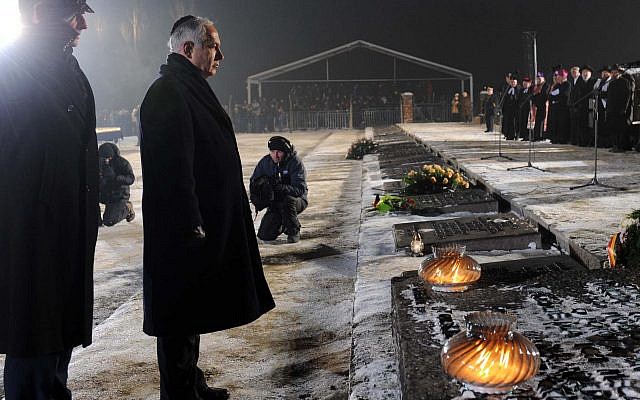
Israeli PM Benjamin Netanyahu marking the 65th anniversary of the liberation of Auschwitz in 2010

And Aaron says, the people were determined to do evil.  They said to me, Make s a god who will go before us because we don’t know what happened to Moses.  So I asked them to give me their gold, threw it into the fire, vayetze ha’egel haze.  And out came this calf.  

Out came this calf.  Kind of a silly moment, in some ways resonant of when you find your child eating cookies before dinner and your child says, suddenly the box of cookies opened up and a cookie flew into my mouth.

The calf didn’t just “come out” of the fire.  The Torah tell us explicitly, verses earlier, that Aaron fashioned the calf himself. 

What Aaron is doing, when Moses asks him what happened, is classic denial.  He retells the story in a way that diminishes his guilt.

Perhaps he knew he was doing this or perhaps he convinced himself that he was less responsible than he actually was - such is the nature of denial.  When we are in denial, we often succeed at fooling ourselves.

I thought it would be helpful to reflect on the problem of denial which, as the ancient Israelites surely understood, is not just a river in Egypt...

Denial - as in, not taking full responsibility for the past, for ourselves, not seeing a situation clearly, not fully accepting the dangers that we or others bring to the table - can often be a stumbling block to the kind of growth and progress that we need.

I want to share with you several examples of how denial - denial of history, denial of reality - can be damaging, and what we should do about it.  Denial is a problem for nations and for individuals.

There are many examples of nations not taking sufficient responsibility for their actions but one which stands out right now is Poland.  

Sunday, February 18, 2018

Thoughts and Prayers are Not Enough

When it comes to life and death, thoughts and prayers are not enough. 

While I was planning what I would say today, days after the deadly shootings at a Florida High School, I was eating lunch at home.  Lunch consisted of a leftover piece of sautéed wild salmon and a side of raw organic kale.  And I thought - this is a caricature of an east coast self-righteous liberal lunch.  And how sad is it that as a country we can’t seem to talk about anything without labeling each other politically in ways that stereotype and shut down the conversation.  You talk this way, eat that way, and we have very little to say to each other.


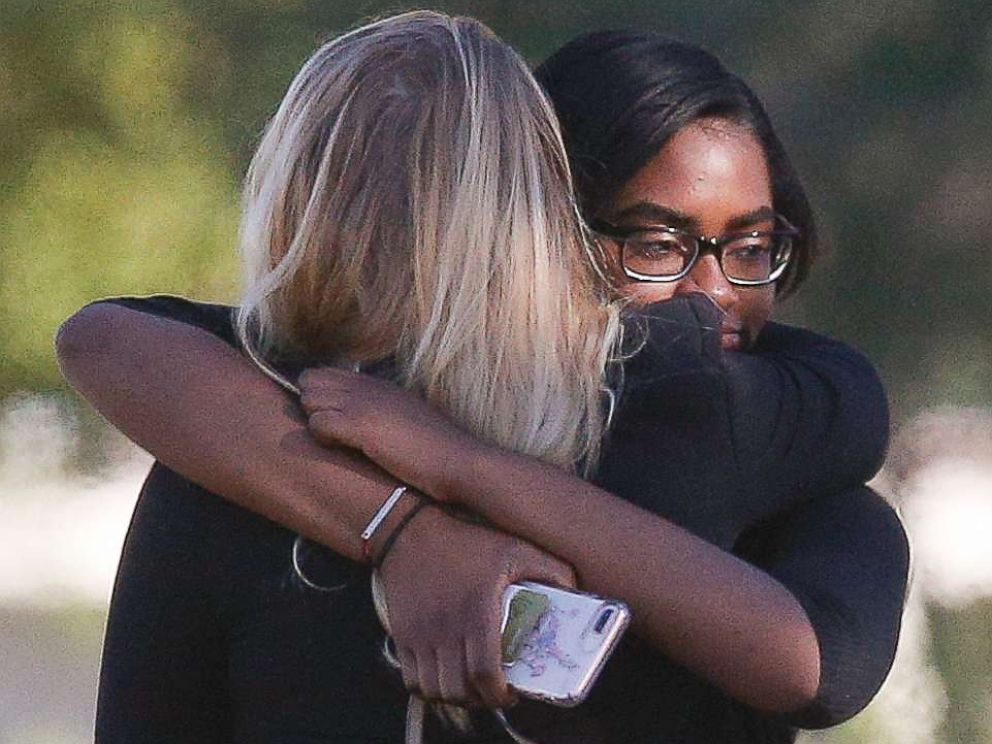
Two people embracing before the funeral of Alyssa Alhadeff, 14, a victim of the Parkland shootings

But I’m not standing here today to talk about lunch.

I’m standing here to talk about what we can all do, as Americans - left, right and center - to make sure that the horrible things that are happening in our country are less likely to continue happening.  

17 people in Parkland, Florida - students and teachers - don’t have the luxury any more of worrying what to have for lunch. They were gunned down by someone carrying a semi-automatic weapon.

Was he mentally unstable?  It appears so.  Was it hard for him to get hold of the weapon he used?  Not at all.

Tuesday, February 6, 2018

Listening is the Beginning of Redemption: A Week in Guatemala

Last Sunday I flew home from a week-long trip to Guatemala with inspiring rabbinic colleagues and the wonderful staff of American Jewish World Service (AJWS).

We spent time in three cities - Guatemala City, Quetzaltenango and Antigua - meeting with leaders of organizations that AJWS supports.  Organizations that are fighting for women’s rights, for freedom of expression, for land rights.


I'd like to share some of my impressions from the trip and then to focus on what several people I met taught me about listening.

Thursday, January 25, 2018

Photos from My Recent Human Rights Trip to Guatemala

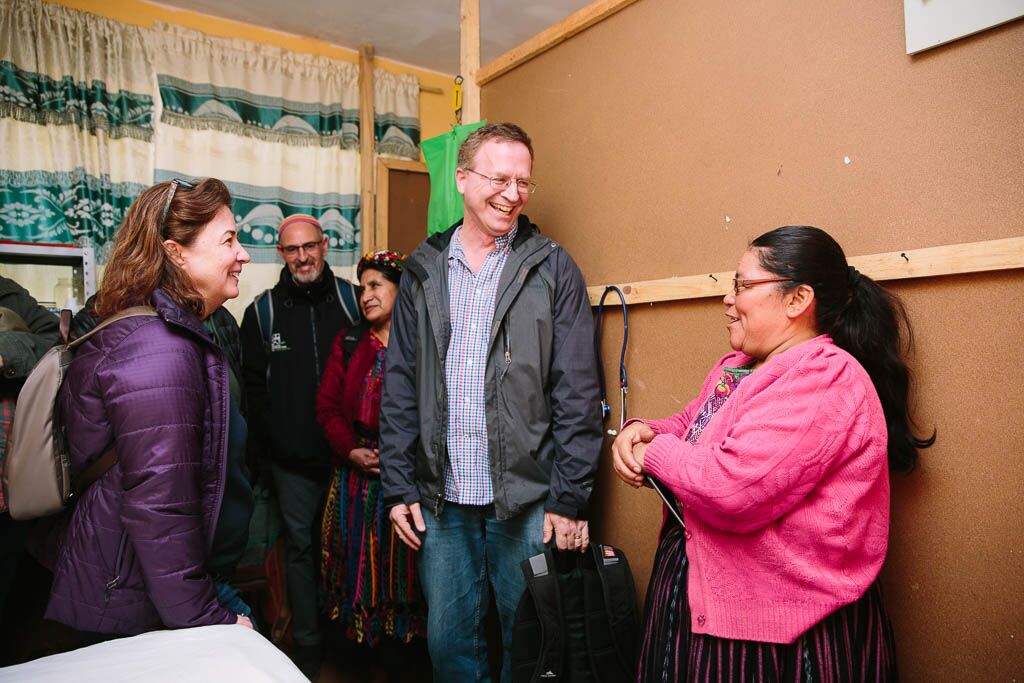
My colleagues and I recently returned from an extraordinary human rights trip to Guatemala led and sponsored by American Jewish World Service - AJWS. "How was your trip?" I've been asked numerous times since I returned. Just for a start: It was beautiful, troubling, uplifting, tragic and downright inspirational. 

Here is a video and some photos I took during the trip, along with brief narrations. The photos include journalists, midwives, healers and women's rights activists, as well as the intoxicating beauty of the land. More reflections to follow. 

When asked what gives him the strength to oppose injustice and to speak and write the truth at great personal risk, an independent community journalist invoked his Mayan heritage and said, "Our ancestors always taught us the importance of speaking the truth and fighting for what is right."

One of many moments that I felt a deep connection and a lump in my throat. 

So much courageous work being done. So much to support. So much more to do in Guatemala, the US, and throughout the world. 

For we, too, have ancestors who have taught us to speak the truth and to fight for what is right.


A member of Asociacion Nuevo Horizonte (New Horizons), created by Mayan Q'eqchies women to advance political participation for indigenous women in local, municipal and national leadership. She is speaking Q'eqchie and sharing her hope and advocacy for equal right for men and women, which she believes will be beneficial to all.


Each day began with a reflection with colleagues, all participants in AJWS's Global Justice Fellowship program.


Professionals and client from Bufete Juridicio de Derechos Humanos, a highly-respected legal organization which represents communities and individuals whose rights have been violated or condoned by the state. The case they shared with us pertained to the land rights of an indigenous community.


We toured the Casa de la Memoria, chronicling the often tragic history of Guatemala and dedicated to the memory of those who were killed from the Spanish conquest to the present.


On the way from Guatemala City to Quetzaltenango, a coffee break in a beautiful setting. 


A corn-husk wrapped tamale, part of a lunch graciously prepared by our hosts at CODECOT, a coordinating agency of traditional local midwives.


CODECOT participants presenting a skit to illustrate the limitations posed by local hospitals and the need for a strong midwife cohort to address women's health needs.


Rabbi Ilana Schachter presenting a plaque from AJWS to the CODECOT leadership for their efforts to promote sexual health and to address the institutionalized racism that many encounter in the healthcare system.

With Ruth W Messinger, President of American Jewish World Service (AJWS) from 1998 to July of 2016 and currently the organization’s inaugural Global Ambassador. Quite inspiring to travel with her and to witness her wisdom and experience in global justice.


Breathtaking scenery wherever we turned. Here's one of the nearly 40 volcanoes in Guatemala.


Members of the Pensa Comunitaria, a youth-led collective of independent journalists who cover social justice struggles in Guatemala as an alternative to mainstream media. They do not earn any money for their journalistic work. The woman speaking, for example, is also a dentist.


Getting to know wonderful colleagues from other communities was a real added benefit to the trip. It appears I traveled to Guatemala to spend time with LA colleague Rabbi Noah Farkas.


With one of the participants of Asociation Neuvo Horizonte who traveled seven hours (with her daughter) to speak to us. She shared two of the group's objectives: the establishment of a women's political party and women mayors for the towns in which the participants live.


We spent Shabbat at a coffee resort near Antigua, Guatemala.  The picture is taken from the inside of a pagoda where we held services. 


Sign spotted in the airport as we were preparing to leave, prompting an august rabbinic caption contest. Winner so far: travel tips.

Sunday, January 7, 2018

Choice and Responsibility Are Good Jewish Obsessions

David Grossman’s book, See Under Love, provides a powerful reflection on the impact of the Shoah.  It begins by telling the story of a child of survivors growing up in Israel in the 1950’s and quickly reveals that the child’s great uncle wrote children’s stories during the war.

Turns out that the great uncle wrote the stories at the request of a Nazi officer in the concentration camp in which he was imprisoned.  In a perverse, opposite take on the Scheherezade story, the officer promised that if the Jew told him stories, he would put him out of his misery.


It’s a complex, poignant book.  The author and the officer have a cat and mouse relationship characterized by mutual disdain.  

Among various issues raised as their relationship unfolds, the author speaks to the officer about responsibility and choice.  It’s the last thing the officer wants to hear; he thinks of these things as pesky Jewish obsessions.

The officer says that initially it was difficult for him to act violently.  He had to choose to pull the trigger, to inflict torture.  But eventually he got accustomed to killing and torturing and he no longer had to make the choice consciously.  He trained himself to “turn off a part of his heart” so that he could do his part to bring about the Third Reich.

The author insists in response that a human being is not a machine.  And he challenges the officer by saying, every time you act, you are making a choice.  

The Torah at the beginning of the Book of Exodus plunges us into a story about slavery.  ויעבידו מצרים את בני ישראל בפרך Vaya’avidu mitzrayim et benei yisrael b’farech.  "Egypt enslaved the children of Israel with hard labor." (Exodus 1:13)  Slavery by definition is an attempt to deprive people of choice.  

And yet the story immediately focuses on choices.  Choices that people make which require considerably bravery.