Wednesday, April 25, 2018

Are You With Me?

The Torah portions for this week - tazria-metzorah - often have a bad image.  Oh - those are the ones that speak about sickness and sores and mildew.  And how the kohen, the priest, would diagnose a person's condition and help the person to reenter the community.    If you have to give a talk about these portions, people may sometimes offer you their compassion. 

But the portions are actually essential.  In fact, without them, the Torah doesn’t really work, its underlying message is largely untested. These portions test whether or not the Torah works.  

I’ll come back to that.  


Vera Eden and Dr. Eva Ebin, cousins and Shoah survivors

Last week we commemorated Yom Hashoah, Holocaust Memorial Day.  Vera Eden, longtime member of the congregation, Jewish educator for decades, spoke with passion and strength about her experiences as a teenager in Auschwitz.  She described how she was taken there, separated from most of her family, what she heard and saw on typical days and atypical days, how she felt at each moment, how the Nazis tried to deceive the Jews at each point.  She conveyed the horror, the terror, and the very rare moments of hope.

Sunday, April 8, 2018

I Matter and You Matter: A Passover Message

We’ve reached the end of Passover and I want to speak about some difficult challenges that are facing the Jewish people in terms of how others relate to us and we relate to the rest of the world.  


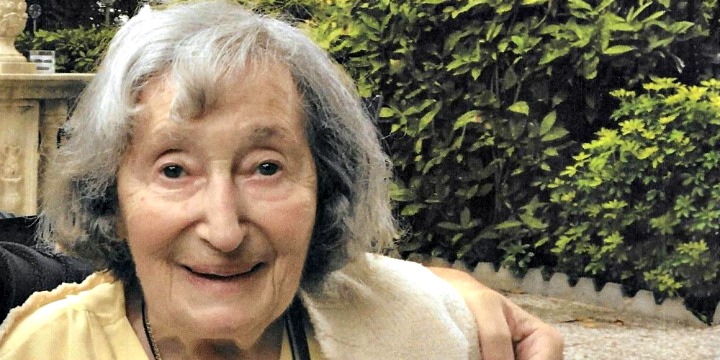
Mireille Knoll, Holocaust survivor and humanitarian, z"l

What I’ve noticed is - by and large, people older than I am emphasize the importance of protecting the Jewish people and people younger than I am take a more universal view.  

This is a generalization to be sure.  You may surely say, I’m older than you and I am very universal in my thinking.  And you may be younger and say I totally see the need for protecting the Jewish people.  And you may say, I see both sides, I get the subtlety - and I’m sure that many of us do.  I know that I’m generalizing by generation.  But still…

I want to give 2 mini-sermons.

First off - here’s the sermon that I think many younger people could benefit from hearing.  It’s based on a famous passage in the Haggadah that begins with b’khol dor vador.  In every generation.

בכל דור ודור עומדים עלינו לכלותנו 

B’khol dor vador.  Om’dim aleinu l’khaloteinu.  

In every generation, enemies rise up against us to destroy us.

Maybe you didn’t experience much discrimination for being Jewish in school, in college, and professionally.  Maybe you weren’t called names, or spat at, or worse.

Please consider - that discrimination and persecution against Jews has always been a reality, and that it is still a reality - even if it hasn’t affected your life very much or at all.  

Monday, April 2, 2018

We Must Learn How To Leap

Years ago I had an interesting conversation with a colleague of mine in West Hempstead.  He said that usually he encourages people in his community to take gradual steps when it comes to making changes in their lives.  Not to do anything all at once.


With Senator Kirsten Gillibrand

But there’s one time a year that he encourages people to leap forward.  Not to take small, cautious steps but to leap.

And that time of year is Passover.  There’s actually a basis for this - I’m not making it up!  On Passover we read Song of Songs - a series of love poems - and - as my colleague pointed out - Song of Songs speaks of a lover leaping over the mountains - מדלג על ההרים m’daleg al he’harim. 

This is the time for us to learn how to leap.  

Monday, March 26, 2018

From Shame to Celebration

Last week Rabbi Mark Borovitz spent Shabbat with our congregation and spoke to us about his story.  He was jailed for theft.  He lied repeatedly to people, including family and friends.  He is a recovering alcoholic.


For years he has been the senior rabbi of Beit T’shuva, a residential treatment center that has helped thousands of people with various addictions to manage those addictions and to lead responsible, productive, purpose-driven lives.

He and I were schmoozing Shabbat afternoon about our lives, our work and our communities.

And we identified one major theme which affects his community and our community - many communities, in fact - something which is at the root of so much of our unhappiness and which prevents us from moving forward in healthy ways.

And that is shame.  Shame is powerful, corrosive, debilitating.  And it comes from so many different places.

Shame.  The feeling you might have when you are addicted to a substance or a behavior and can’t stop.

Shame.  The feeling you might have when you are experiencing financial difficulties and can’t provide adequately for your loved ones.

Shame.  The feeling you might have if you think or know that you’re gay or trans and people around you make jokes or comments that suggest that such people are immoral or crazy or less than.

Shame.  The feeling that you might have if your friends are bragging at the kiddush about how their children are dating “nice Jewish boys and girls” and your child is dating someone of another faith and you’re wondering if you can talk about it.

Shame.  The feeling you might have if you’re in middle school or high school and you’re the last one picked for the team.  Or it’s hard for you to process the instructions that your teacher is giving to the class.  Or you don’t like the way your body looks.

Shame.  The feeling that you might have if you don’t want to take an honor in the synagogue because your Hebrew isn’t so good.  Or you struggle to walk.  Or you’re not sure if you are good enough to deserve the honor.

Shame.  The feeling you might have if your memory isn’t what it used to be and you can’t keep track of things so well and the people around you are noticing.

Shame, often, is a combination of how we feel internally and how we imagine, or know, that others around us feel about us, about our choices, our situation, our essence.

Thursday, March 22, 2018

The Best Place in the World

In 1986 I spent my junior year of college studying in England.  I used one of the vacation breaks to visit my friend who was spending the year in Israel and we had a wonderful time.  On the way back to the airport, I listened to the cab driver complain incessantly about living in Israel.  He expressed frustration with the government, the cost of living, the high level of stress.  You name a topic and he complained about it.  As we were pulling up to the airport, he asked me, “So when are you going to make aliya?”  

I was a little surprised.  I said to him, “You spent the last hour complaining about everything having to do with Israel and you want me to come live here?”  I’ll never forget his answer.  “Forget all that.  Israel is the best place in the world.”


Israel was ranked 11th in the most recent Global Happiness Index, an annual ranking which measures well-being in areas that include education, environment, emotions and citizens engagement.  Israel scored higher than the United States and the United Kingdom.  Considering all of the internal and external challenges that Israel faces, this is truly remarkable. 

As Israel prepares to celebrate the 70th anniversary since her establishment as a modern state, we at Temple Israel are doing a number of things to mark the occasion.  On the evenings of April 16, 23 and 30, Rabbi Schweber and I will be a teaching a mini-series entitled “Israel at 70,” focusing on some of the major milestones in Israel’s history.  

Sunday, March 4, 2018

Overcoming Denial in Poland, the US, and Our Own Souls

Denial is a human phenomenon but it’s a harmful phenomenon.  

There are so many memorable scenes in this morning’s Torah reading, many tragic scenes, but only one that is slightly odd, even silly.  It’s the scene where Aaron denies the magnitude of his role in creating the calf that the people worship.  

After Moses comes down from the mountain and sees the people dancing around the calf, he asks his brother, Aaron, what did the people do to you that you brought such a huge sin on them?


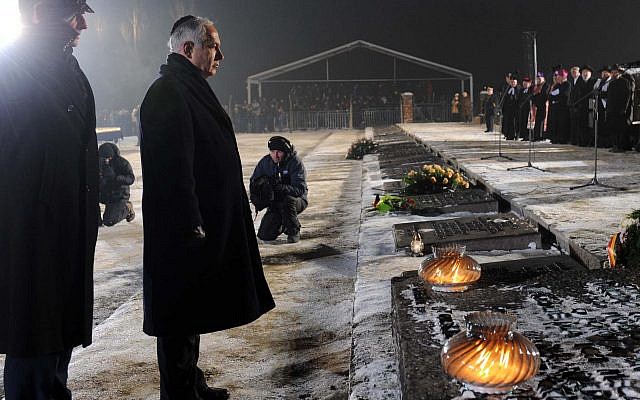
Israeli PM Benjamin Netanyahu marking the 65th anniversary of the liberation of Auschwitz in 2010

And Aaron says, the people were determined to do evil.  They said to me, Make s a god who will go before us because we don’t know what happened to Moses.  So I asked them to give me their gold, threw it into the fire, vayetze ha’egel haze.  And out came this calf.  

Out came this calf.  Kind of a silly moment, in some ways resonant of when you find your child eating cookies before dinner and your child says, suddenly the box of cookies opened up and a cookie flew into my mouth.

The calf didn’t just “come out” of the fire.  The Torah tell us explicitly, verses earlier, that Aaron fashioned the calf himself. 

What Aaron is doing, when Moses asks him what happened, is classic denial.  He retells the story in a way that diminishes his guilt.

Perhaps he knew he was doing this or perhaps he convinced himself that he was less responsible than he actually was - such is the nature of denial.  When we are in denial, we often succeed at fooling ourselves.

I thought it would be helpful to reflect on the problem of denial which, as the ancient Israelites surely understood, is not just a river in Egypt...

Denial - as in, not taking full responsibility for the past, for ourselves, not seeing a situation clearly, not fully accepting the dangers that we or others bring to the table - can often be a stumbling block to the kind of growth and progress that we need.

I want to share with you several examples of how denial - denial of history, denial of reality - can be damaging, and what we should do about it.  Denial is a problem for nations and for individuals.

There are many examples of nations not taking sufficient responsibility for their actions but one which stands out right now is Poland.  

Sunday, February 18, 2018

Thoughts and Prayers are Not Enough

When it comes to life and death, thoughts and prayers are not enough. 

While I was planning what I would say today, days after the deadly shootings at a Florida High School, I was eating lunch at home.  Lunch consisted of a leftover piece of sautéed wild salmon and a side of raw organic kale.  And I thought - this is a caricature of an east coast self-righteous liberal lunch.  And how sad is it that as a country we can’t seem to talk about anything without labeling each other politically in ways that stereotype and shut down the conversation.  You talk this way, eat that way, and we have very little to say to each other.


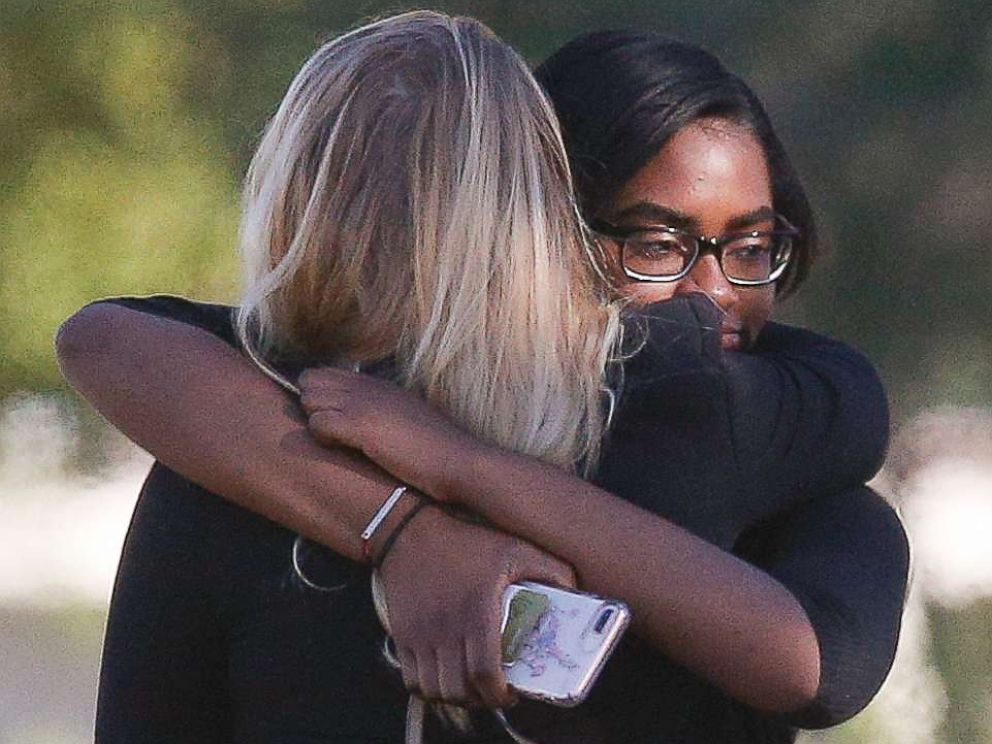
Two people embracing before the funeral of Alyssa Alhadeff, 14, a victim of the Parkland shootings

But I’m not standing here today to talk about lunch.

I’m standing here to talk about what we can all do, as Americans - left, right and center - to make sure that the horrible things that are happening in our country are less likely to continue happening.  

17 people in Parkland, Florida - students and teachers - don’t have the luxury any more of worrying what to have for lunch. They were gunned down by someone carrying a semi-automatic weapon.

Was he mentally unstable?  It appears so.  Was it hard for him to get hold of the weapon he used?  Not at all.