Wednesday, January 6, 2016

Changing Unhealthy Patterns

I imagine you have heard the joke I’m about to share, but please bear with me since I’m sharing it for a higher purpose...

Joan lives at home and has been looking for the right man to marry, but time after time it doesn’t work out because her parents don’t approve of whomever she brings home.  She goes to her friend for advice, the friend says – “Joan, find someone just like your father and bring him home for dinner.”  Which Joan does.

The next day, Joan’s friend asks how it went and Joan says,  “It was terrible.”  “What happened?”  “Well,” Joan says, “My father loved him.”  “So what was the problem?” her friend wonders.  And Joan says, “Unfortunately, my mother couldn’t stand him.”

In case you were wondering what happens when you Google “marrying someone like you father,” now you know...

To a large extent, for a host of reasons, we tend to maintain the same patterns of behavior, generation after generation.  Even when we want to act differently, even when we are convinced that we should make changes, we tend to replicate certain patterns. 

Suppose we truly want to make progress?  Suppose we recognize that we absolutely must address areas that are problematic?

The extended narrative we’ve been reading in the Book of Genesis about several generations in the life of a family may be instructive.  This is a family has had its share of tsorres, its share of aggravation.  


Murillo, "Joseph and his Brethren," c. 1670

And it also has an array of interesting personality traits and patterns.

This is a family that keeps secrets, where people aren’t always truthful to one another, where people keep animosity inside until it ruptures and causes them to act in treacherous ways, where siblings compete with one another with results that are often tragic.

That’s certainly true of the generation of Jacob.  And what about the children, Joseph and company?  Perhaps not surprisingly, you see some of the same traits.

But the book of Genesis offers the possibility that the current generation can break free of some of the negative patterns of the previous generation and also maintain the positive.  

Thursday, December 17, 2015

An Important and (Sadly) Controversial Visit

Naftali Bennett’s recent visit to the Solomon Schechter School of Manhattan was eagerly anticipated by the entire school community.  After considerable planning, Bennett, who serves as Israel’s Minister of Education and Minister of Diaspora Affairs, spent several hours at the Schechter School on December 1. 


Minister Bennett visiting the Solomon Schechter School of Manhattan on December 1, 2015

I received a full description of the planning and the actual event from my wife Deanna, who is the school's coordinator of learning support and serves on its Educational Leadership Team.  Among other things, Bennett had conversations with middle school students and adults and shared stories and songs with the entire school.  A video showed him sitting on the floor with the children and singing along to some popular Israeli tunes.

That same day, along with the video, Bennett tweeted the following message, in Hebrew, to his approximately forty thousand followers:  “Meeting with the students of the wonderful Conservative Solomon Schechter School in New York.  Such love of Israel.  Such love of Judaism.”

Naftali Bennett, who personally identifies as Modern Orthodox, had unabashedly revealed the school’s affiliation and indicated how impressed he was.  Deanna informed me that the students and parents were likewise impressed by Bennett’s down to earth manner and ability to engage.  So far, so good.

Subsequently, however, several people castigated Bennett for having visited the school.  Among his critics was Chief Ashkenazi Rabbi David Lau.  According to Israeli newspaper Haaretz, Rabbi Lau said in a radio interview,  “you should not go to a place that explicitly belongs to groups that you know don’t respect klal yisrael (the Community of Israel).” 

In response, Naftali Bennett’s office issued the following statement: “Minister Bennett believes that public leaders in Israel need to bring Jews closer and not alienate them, and he views comments that alienate rather than bringing people closer with major concern.”

I especially appreciated a letter written to Rabbi Lau by Daniel Labovitz, former president of the school, in which he wrote, “You insulted me directly and personally, Rabbi, when you said that this school, of which I was president for four years, and which has educated both of my sons to love Israel, explicitly belongs to groups that you know don’t respect klal yisrael.  You insulted me directly and personally, Rabbi, when you said that my son, who sat next to Minister Bennett on the floor and sang, "yachad, lev el lev niftach b'tikva,” (“together, we will open each other’s hearts with hope”) doesn't respect klal yisrael.  You insult me personally because two of the graduates of Schechter Manhattan are currently serving in the IDF, defending klal yisrael, something that most of the Haredi men their age aren't doing.”

On Rosh Hashanah and Yom Kippur, we sing the prayer, hayom t’gadleinu.  Today, make us larger.  On Hanukkah, we follow the opinion of Hillel by increasing the number of candles we light each night so that we can increase holiness in the world.  How sad that Rabbi Lau chooses to reduce rather than enlarge, to be incapable of seeing an abundance of holiness even when it is coursing through the hearts and souls of children and the adults who love and guide them.

Fortunately Naftali Bennett knows better, and so do we.  At the Solomon Schechter School of Manhattan, at Temple Israel of Great Neck and at numerous other places across the globe, we understand that there are multiple paths toward embracing the beauty of our heritage and enhancing the glory of klal yisrael. 

Originally written for the Temple Israel Voice, December 18, 2015 edition


Tuesday, December 15, 2015

Where Everyone is Really Welcome: a Vision for Temple Israel of Great Neck

Thousands of years ago, our ancestors told a story about a man who was afraid to reunite with his brother after a rift that had occurred several decades prior.  He took a variety of precautions, sent his family along ahead of himself, and was left all alone.  Another man appeared and struggled with him until dawn. 


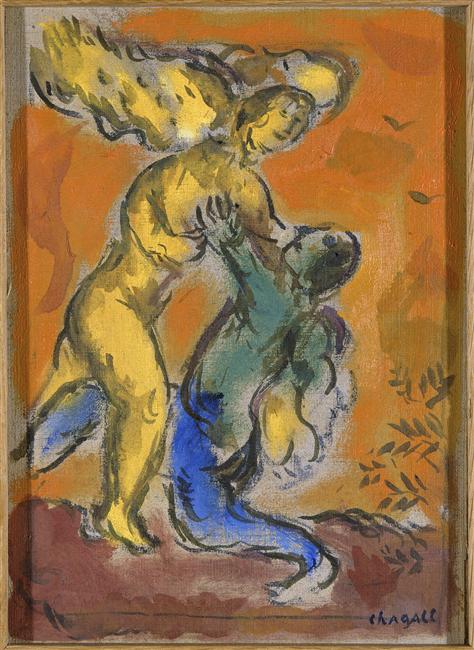
 Jacob Wrestling with the Angel by Marc Chagall

These moments in the life of our patriarch Jacob, moments of isolation and struggle, are not hidden from us.  They were described and recorded and, not only that, they became essential to his identity and to his new name, Israel, ישראל Yisra’el.

Which became the name for the nation, ישראל yisra’el, who are known as בני ישראל b’nei yisra’el, the children of Israel.

I have some questions for all of us on this beautiful Shabbat morning of Thanksgiving weekend. 

Given that our ancestor was Yisrael – who struggled, prevailed, complained and prevailed again.  And that our people bear his name.  And that our synagogue bears his name.  

Why do we exert so much energy pretending that everything is just fine when it’s not?  

Why are our synagogues, this one included, places where by and large people feel uncomfortable sharing anything beyond, “I’m fine, thank you”?

Why is it that in 2015, people whose life circumstances are other than happily married with high-achieving children sometimes wonder if they are fully welcomed here and in other synagogues?

How did the children of Israel – tormented dreamer and struggler, Israel who has good days and lousy days, Israel who sometimes supports his children and sometimes messes up spectacularly with regard to his children, Israel whose roller-coaster of a life is captured in unflinching detail in our Torah, Israel who is asked at the end of his life how he’s doing and says, “badly, thank you for asking” – how did the children of Israel come to believe that they are being measured, explicitly or implicitly, against certain narrow expectations and that they have to come into God’s house appearing to have it all together even when they don’t?

It’s exhausting.  It’s debilitating.  And the craziest part of it is that it isn’t even authentic to our tradition.

Friday, November 20, 2015

The Power of Expectation

Ellen Langer was a young psychology professor at Harvard in 1981 when she conducted an experiment that would become highly influential in her field.


Professor Ellen Langer, Harvard University

She took two groups of men in their 70’s and 80’s to a rustic hotel.  The first group was told that they were going to spend a few days reminiscing about the 1950’s, which they did – they talked, they laughed, they remembered.

The second group, which came a week later, was told to spend a few days inhabiting the 1950’s – in other words, to actually relive life as their younger selves.  This was accomplished in concrete ways.  For example, the second group, unlike the first, was told to bring their own luggage to their rooms rather than have porters take it. 

Both groups were measured for physical and cognitive function before and after their stay at the hotel.

There was a noticeable difference between the two groups at the end of their respective stays.  The group that inhabited their earlier lives were significantly more energetic and capable than the other group.  They were more boisterous and more lively.  

While waiting for the bus following their stay, they broke out into a game of touch football which they said they hadn’t played in years.

Ellen Langer’s experiment, shared recently with a group of clergy by Dr. David Pelcovitz of Yeshiva University, demonstrated, more dramatically than she even imagined, the power of expectation.  The men who were expected to act youthfully quickly came to expect that of themselves.  They didn’t fully regain the dynamism of their youth but they were far more agile than they had been and more agile than those in the other group.

In our concern for not overwhelming people, for allowing people latitude and freedom, for not imposing on people, we may be going overboard by failing to hold, and to convey, sufficiently high expectations.

I'd like to unpack the dynamics of expectations, starting with the Torah and then encouraging us to consider how high expectations, appropriately conveyed, can have a positive impact on others, as well as on ourselves.

Wednesday, November 11, 2015

Walking Together: The Challenge and Joy of Parenting Adult Children

Recently I was chatting with someone.  He told me what his children were up to.  He asked what my children were up to.  

I started by telling him what our oldest was up to – that he’s been working in a vineyard in Vermont, involved in the growing of the grapes and the making of the wine.  I didn’t get to our other children.


He said, “So you’re letting him do that?”

I wasn’t sure what he meant exactly, so I asked for clarification.

He said, “I guess you figure your son is still young, he needs to get this out of his system, so you’re letting him explore it before he settles down.”

I thought his comments were curious and I tried to unpack what might have been some of the assumptions behind what was said.  Here are three that I came up with:

An assumption that certain types of work are more worthy of support than others.

An assumption that I as the parent would not approve of the type of work my son is doing.

An assumption that even if I didn’t approve of it, I would or could stop him from doing it.

I’ll get back to my son - the vibrant Vermont vintner - eventually.

I want to reflect this morning on the extent to which parents impose their visions and aspirations onto their children. 

Thursday, October 22, 2015

The Censored Life is Not Worth Living: Reflections on Our Land, Our Tradition and Our Lives

The poet Yehuda Amichai imagined what it would be like to go through the Bible and censor the parts that are distasteful or painful.

To explore this concept he wrote the following poem:

From the Book of Esther I removed the sediment
of vulgar joy, and from the Book of Jeremiah
the howl of pain in the guts. And from
the Song of Songs, the endless
search for love. And from the Book of Genesis,
the dreams and Cain. And from Ecclesiastes,
the despair, and from the Book of Job: Job.
And with what was left, I pasted myself a new Bible.
Now I live censored and pasted and limited and in peace.
A woman asked me last night on the dark street
how another woman was
who’d already died. Before her time – and not
in anyone else’s time either.
Out of a great weariness I answered:
Shloma tov, shloma tov
She’s fine, she’s fine.

The fantasy of living a censored life, adhering to a censored Judaism, pledging allegiance to a censored Israel certainly has its appeal.

To the question, how are we doing, on all fronts, we can say, “fine, fine” thank you for asking.

But I wonder – and I guess this may well be Amichai’s point – what is the cost of all of the censorship that we inflict on our lives, our religion and our land? 

Thursday, October 1, 2015

We Change When We Need To: A Message for Yom Kippur 5776

Several months after my father died, back in 1996, Deanna and I and our boys, all younger than 6 at the time, moved from Roslyn to West Hempstead.  My mother said, a few weeks after we moved to the new house, I’m going to drive out to see you.

That may sound like nothing to you.  But she might as well have said to me, sweetheart, the day after Passover we’ll do brunch on top of Mount Everest. 


My mother didn’t like to drive.  She got anxious when she needed to drive.  She had a poor sense of direction. 

Once when my sisters and I were little, after we’d moved to New Jersey and she took us back to see our ophthalmologist in Brooklyn because my father couldn’t drive us at the time, she got lost on the way back.  She began a sentence with, “If we ever get home…”

When we were growing up, my mother only drove when she absolutely had to, only locally and she defined what was local.

Driving to Long Island from New Jersey, requiring the crossing of two bridges, to an address she’d never been to, was a big deal.

Yom Kippur is supposed to be about reflection and resolution and the possibility of change. 

In his book, Halakhic Man, Soloveitchik wrote that teshuva, repentance, change, is an act of self-creation.

Maimonides said that we’re not just supposed to change our actions, we’re supposed to change our personalities. 

Last month I got an email from the head of a rabbinic organization urging rabbis to talk to their congregations about Pope Francis’s encyclical regarding climate change and economic inequality. 

And I want to say, to Soloveitchik, to Maimonides, and to the author of the email about the Pope, “Don’t you understand that it’s really hard to change, forget about the global issues – it’s hard to drive from New Jersey to Long Island when someone else used to do it.  It’s hard to deal with life day to day when it throws us God only knows what.  And you’re asking us to think about self-creation and personality transformation and the relationship between melting icebergs and growing income gaps?”

I’m going to offer some Yom Kippur heresy and here it is.  Ladies and gentlemen:  we don’t change.