Tuesday, May 23, 2017

Celebrating Jerusalem and Israel 50 Years Later

A few months ago a college friend who lives out of town sent me an email asking what we were planning to do as a synagogue to commemorate this upcoming Jerusalem Day, Yom Yerushalayim, 50 years since Israel's victory in the Six-Day War.  

I said, we're going to be having a concert in a local park, we're going to sing and celebrate. 


Yom Yerushalayim Concert, May 21, 2017, Great Neck, NY

He wrote back – interesting.  You know that there are rabbinic leaders that are struggling with whether or not they and their communities should celebrate.  

I knew what he was referring to.  Since1967 was also the beginning of the annexation of the West Bank, it also marks the beginning of the occupation.  So colleagues of mine, in light of that outcome of the Six-Day War, are ambivalent about celebrating Jerusalem Day.  Perhaps the day should be devoted more to solemn study and reflection, some are saying.

He wasn't expressing his opinion, he was giving me a sense of what he's been reading and observing.

Since I've known him for a long time, I decided I wasn't going to continue the conversation through emails.  So I picked up the phone and called him and I started to get excited.

Tuesday, May 9, 2017

Maybe the "Blind Person" is You or I

A Greek filmmaker named Nancy Spetsioti produced a powerful short film.  In the film a couple and their young daughter walk into a doctor’s waiting room.  They all sit down when the mother notices that the little girl just seated herself next to a young man with darker features than the family members have.  The mother switches seats with the girl.  The father gives his seat to the mother and stands nearby, leaving the seat next to the young man empty.  They look at at him suspiciously, he looks down awkwardly.

The family is told that the doctor is ready to see them and that he would also like the young man to come inside as well.  


Scene from "Jafar," directed by Nancy Spetsioti

The family walks in, followed by the young man.

The doctor happily observes that the little girl looks strong and well following her surgery.  And then he walks over to the young man, puts his arm around him, and says to the family, “Let me introduce you to Jafar.  He is Anna’s bone marrow donor.”

Jafar smiles gently, the family look at him and at one another.  The film ends.

I looked for reactions to the film on-line.  One person wrote, he must be a Muslim.  Another wrote, he’s Turkish, and a Greek family would consider him to be the enemy, untrustworthy.  

The film appears to have been created to call into question the assumptions that we make about one another before we know each other well, or even at all.  

I thought it would be worthwhile to explore the Jewish perspective on how we judge one another.  What do we assume when we see someone?  When we know, or think we know, something about the person's racial, cultural, ethnic identity and other aspects of his or her life?

Wednesday, April 19, 2017

Turning Our Worry Into Action

When I was in college I spoke to my parents about once a week, usually on Friday afternoons.   In addition to the general back and forth, my mother would usually ask if I was getting all my work done.  

I wondered at the time why she was still worried about this.  I was, after all, 20 years old and managing reasonably well.


Years later, when I was a rabbi and we would talk before the holidays, she would ask if I was getting my work done.  Are the sermons going to be ready?

I used to think that my mother worried more than my father since she usually asked the questions, but one week when I was a teenager and she took off to visit my aunt in Cincinnati and left him to “take care of me,” he worried non-stop.  

I’m sure that worrying is universal, but Jews certainly have a reputation for it.  We even have our own jokes about worrying, including one I expect you’ve heard.

What does the classic Jewish telegram read?

Start worrying.  Details to follow.

Passover is known as the season of our freedom.

Thursday, April 13, 2017

Listening Brings Freedom and Life

My paternal grandfather lived until his early 90’s.  Toward the end of his life we went to visit him in the hospital.  He was suffering.  

One of us, I don’t remember who, asked how he was feeling.  He said, “I’m dying.”

One of the family gathered there said something like, “Oh, you’re trying. Of course you’re trying.  It must be hard but you’ll be OK. We love you."

He didn’t say I’m trying.  We knew that.  He surely knew that.

We don’t always listen very well.  Sometimes when things are actually said we pretend we didn’t quite hear them, especially if what was said was too painful or even inconvenient.  


My grandfather might have gained some comfort from us telling him that we actually heard what he said instead of pretending we didn’t hear and that everything would be ok.  We won’t ever know.

The foundation of the Passover story is listening.  

Tuesday, April 4, 2017

Me at AIPAC 2017: Appreciation, Challenge and Suggestions

I spent Sunday through Tuesday at the AIPAC national policy conference.  AIPAC – the American Israel Public Affairs Committee – was founded in 1963.  Its stated mission is “to strengthen, protect and promote the U.S.-Israel relationship in ways that enhance the security of the United States and Israel.”

I’d like to share some highlights from my perspective along with some of the challenges I experienced as a participant.  Using my reactions as a guidepost, I hope to reflect on how each of us might navigate when it comes to our own social and political views and our relationship to Israel.  Ultimately I hope to suggest how established institutions like AIPAC can support engagement that is deeper and, ultimately, more effective for America and Israel.


Panel on "Shifting Landscapes:  Israel and the African American Community", AIPAC Policy Conference 2017

First the highlights.  There were roughly 18,000 people at the conference.  

Approximately 1000 rabbis attended.

Approximately 4000 college students attended.

The student presidents of approximately 150 colleges and universities were there, including 50 student presidents of historically black colleges.

Thursday, March 23, 2017

What I Want For Me, I Should Want For You

The moment when Moses says to God, “I want to know you.  I want to understand you,” is a moment I think many of us can relate to.  

Perhaps we have sought an understanding of God, or some divine reassurance, to help us make sense of our lives in ways existential and mundane.


We know, however, that our yearning for understanding and reassurance from God, and more specifically our claim that we have such understanding and reassurance, can lead us, individually and communally, to some pretty dark places.


Temple Israel Players 2017

As tempting as it is to want some divine reassurance about our beliefs and our actions, it's also dangerous.  As we well know, we can look to God to help us justify all kinds of things that are problematic, ranging from garden-variety self-righteousness to truly vile behavior.  


The Muslim suicide bomber thinks he is acting in Allah's name. The Christian shooter thinks he is acting in Jesus's name. The Jew who shoots scores of worshippers in a mosque thinks he is doing the will of Hashem.


Two major rabbinic leaders have dared to suggest that when it comes to our behavior we should put God second.  Don't be quick to invoke God, don't be over-reliant on God's blessing. Just do what you know is right and worry about God later.


Wednesday, March 8, 2017

Response to Anti-Semitism: Protecting Ourselves, Protecting Each Other

This past week I was at a wonderful conference sponsored by Hadar with rabbis of multiple ideological perspectives from all over the country

During a particular session I was studying with two colleagues and one of them, who lives in the Philadelphia area, looked down at his phone and said, “Sorry - Gotta step out.”

He came back in and we asked is everything ok, and he said, the Jewish day school that my children go to just received a bomb threat.  All the children are waiting outside.  The leadership is trying to figure out what course of action to take next.


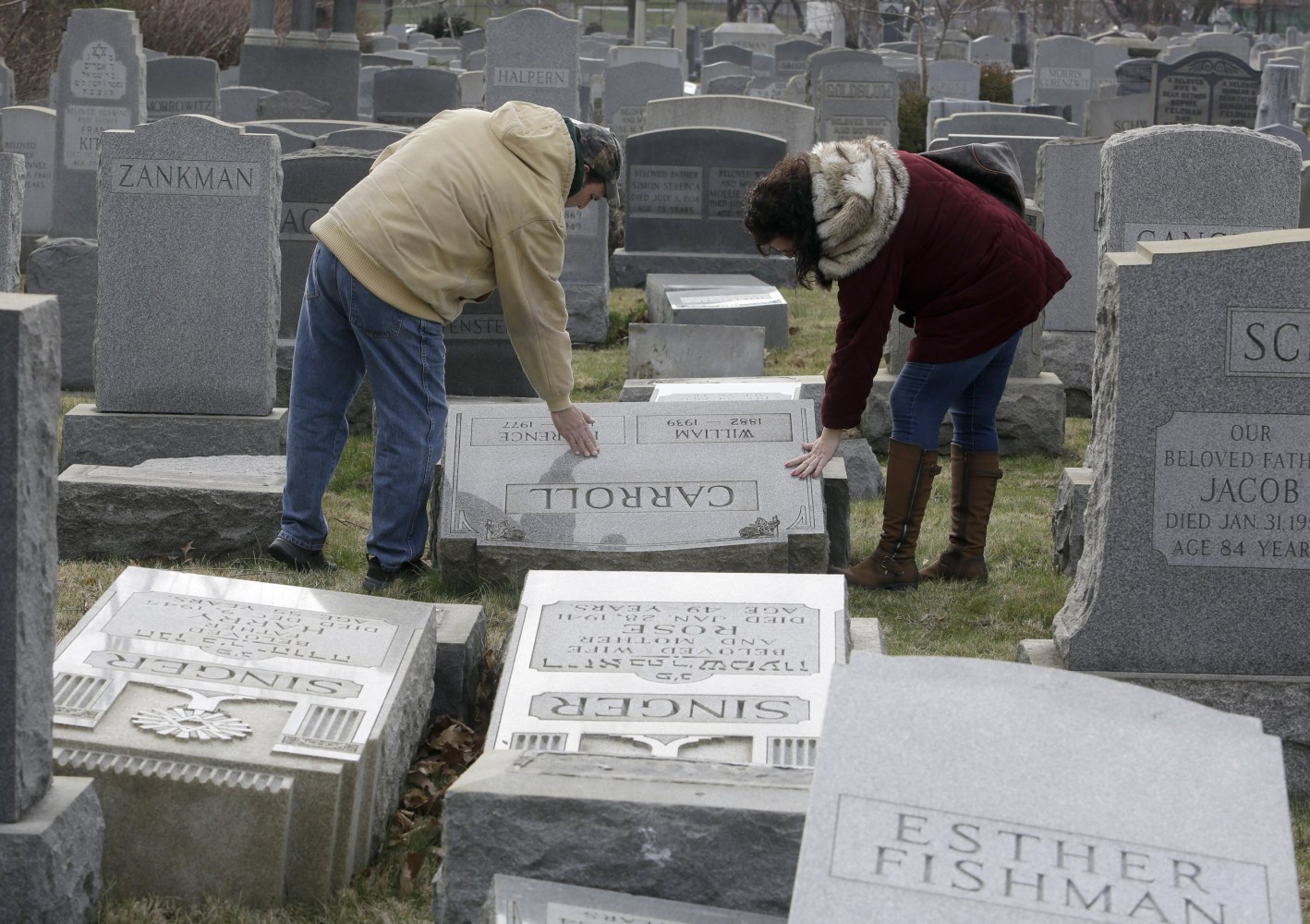
Vandalism at Mt. Carmel Cemetery In Philadelphia, PA, February, 2017

Over the next hours he filled us in on the outcome (everyone was ok), on what the leadership decided to share with the children (K through 5), on what procedures they followed.

This, as we know, is part of a much larger recent trend.