Wednesday, June 13, 2018

Fear Can Be a Good Thing

A classic Bob Newhart episode features a woman speaking to her therapist (played with expert comic timing by the incomparable Bob Newhart) about her fears.  When she finishes, the therapist tells her he has two words that he believes will help her.  She asks him to share the two words and he looks her right in the eye and yells, “Stop it!”  


Moses sends 12 men to scout out the land.  10 see the beauty, but all of the beauty doesn’t matter the moment they lay eyes on the enormous people there.  It is, they tell Moses and the people, ארץ אוכלת יושביה eretz okhelet yoshveha, "a land that eats up its inhabitants."  

They say, אם חפץ בנו ה׳ im hafetz banu Adonai - if God wants us to, we will be able to enter the land.

Fear is natural, but it can paralyze.  When we feel afraid, we usually can’t just “stop it.”
  
Yet fear can also energize.  A group of ballet dancers who direct and perform with the illustrious Alvin Ailey dance troop were interviewed recently on the radio.  They all spoke about how their fear - about performing well, about following in the footsteps (literally) of such great dancers in a company with such a storied reputation - energizes them to work harder, and to dance better.

I want to ask us to reflect on something that makes us afraid and how we handle it. Do we avoid such things altogether?  Or have we learned, can we learn, to lean into the fear, to harness it in fact, and to do what we need to do with energy and resolve?

Monday, June 4, 2018

The Power of the People

Sometimes people ask me how I come up with sermon ideas. I’m not always sure if the question is meant as a compliment…


But I figured, why not share the backstory of how I came up with today’s topic which is about “the power of the people." Specifically, our power and responsibility, from a Jewish perspective and a civics perspective, to create positive change.

So here goes.  Part one of the backstory. 

I was reading about the Irish referendum on abortion and thinking - how interesting that by majority vote, a nation decided to overturn centuries of anti-abortion sentiment and policy.  I read more about that and discovered that for many people, this was part of an effort to increase women’s rights and to bring Ireland in line with the policies of more progressive European countries.  Of course it involved pushing back against Church teachings, which many found repressive in this area and others.

Part two.  The Torah reading describes a moment when Moses acknowledges how great it would be if the entire people would be prophets, filled with God’s spirit.  

In thinking about this part of the Torah reading, I imagined it would be worthwhile to explore what it means for the people - not just the appointed leaders - to participate in charting a course for the community.  

Part three. This was the cosmic clincher, a sign from above.  De and I were watching the final episode of Madam Secretary (a TV show which presents an optimistic view of what government can look like) and the climax of the final episode hinges upon the Secretary convincing the president to bring a tricky international policy to the people and to let them have their say.  The people, in turns out, support a policy that is measured and reasonable.  

I saw that and said, Fate.  Bashert.  Resmat.  This is my topic. The positive impact that "the people" can have in multiple realms, if only we are decent, well-informed and courageous.

Wednesday, May 23, 2018

Choosing Optimism

We choose whether or not to take an optimistic view of the world. 


I had a professor in college who was lecturing about the novel Ulysses by James Joyce.  He said, you can read the novel as highly optimistic and affirming - the world is making progress.  Or you can read it as pessimistic and cynical.  The world continues to repeat its mistakes and might even be getting worse.

On the holiday of Shavuot we celebrate God’s revelation to our people.  A classic view is that it happened on Mt. Sinai at a specific time - there was thunder and lighting, it was very very frightening, and then the revelation was basically complete.

One of the implications of this view is that the further we get from Sinai, the more generations elapse, the less insight we have into what God wants.  This concept is sometimes expressed in the phrase מיעוט הדורות miyut hadorot - the diminishment of the generations.  

I find this view depressingly pessimistic.  The notion that as time goes on we have less and less insight, we are further away from understanding the truth.  To paraphrase Paul Simon, we are dumber than we once were and smarter than we’ll be.  

This is not the only view of God's revelation to us, however. There is also a view which says that God reveals the divine will to us קמעא קמעא kim’ah, kim’ah - a little bit at a time.  The revelation didn’t all occur at once, it occurs over time, like a cosmic time-release capsule.  

I find this view considerably more affirming, more optimistic.  It suggests that the world is improving, that there is progress being made. 

I’ve spoken to number of people about what is happening in Israel lately and depending on who I talk to, it leans optimistic or pessimistic in terms of what people emphasize and what overall narratives they proffer.  

Wednesday, May 9, 2018

Moving Beyond Metrics

I’ve mentioned before that a few year ago we bought a stationary bicycle that allows you to join classes remotely.  


A few times a week I get on the bike, pick a class, and join in.   While you’re biking, there are indicators on the screen that tell you how fast you’re going, how hard you’re peddling and how well you are doing compared to everyone else.


The bicycle knows how old I am.  I must have told it my age in a moment of weakness.  And it knows how old everyone else is.

When I’m peddling along and I see that I’m pulling ahead of people in their thirties I feel great.  Once a few people in their seventies were ahead of me and I told Deanna, we’re getting rid of this bicycle.
Earlier this week I attended a two-day conference at the Hartman Institute’s  NY headquarters and Yehuda Kurtzer, President of Hartman North America, was talking about the challenges facing American Jewish leaders.  And he said one big challenge is that so much of what we do is judged by metrics.

How many come to services or programs?  How fast are your services?  Are you surrounded by 30 year olds or 70 year olds?

Wednesday, April 25, 2018

Are You With Me?

The Torah portions for this week - tazria-metzorah - often have a bad image.  Oh - those are the ones that speak about sickness and sores and mildew.  And how the kohen, the priest, would diagnose a person's condition and help the person to reenter the community.    If you have to give a talk about these portions, people may sometimes offer you their compassion. 

But the portions are actually essential.  In fact, without them, the Torah doesn’t really work, its underlying message is largely untested. These portions test whether or not the Torah works.  

I’ll come back to that.  


Vera Eden and Dr. Eva Ebin, cousins and Shoah survivors

Last week we commemorated Yom Hashoah, Holocaust Memorial Day.  Vera Eden, longtime member of the congregation, Jewish educator for decades, spoke with passion and strength about her experiences as a teenager in Auschwitz.  She described how she was taken there, separated from most of her family, what she heard and saw on typical days and atypical days, how she felt at each moment, how the Nazis tried to deceive the Jews at each point.  She conveyed the horror, the terror, and the very rare moments of hope.

Sunday, April 8, 2018

I Matter and You Matter: A Passover Message

We’ve reached the end of Passover and I want to speak about some difficult challenges that are facing the Jewish people in terms of how others relate to us and we relate to the rest of the world.  


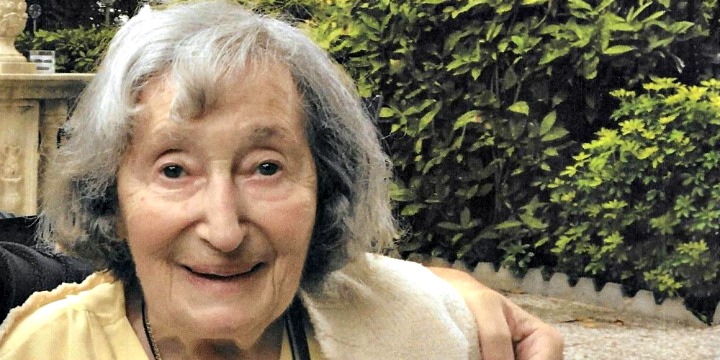
Mireille Knoll, Holocaust survivor and humanitarian, z"l

What I’ve noticed is - by and large, people older than I am emphasize the importance of protecting the Jewish people and people younger than I am take a more universal view.  

This is a generalization to be sure.  You may surely say, I’m older than you and I am very universal in my thinking.  And you may be younger and say I totally see the need for protecting the Jewish people.  And you may say, I see both sides, I get the subtlety - and I’m sure that many of us do.  I know that I’m generalizing by generation.  But still…

I want to give 2 mini-sermons.

First off - here’s the sermon that I think many younger people could benefit from hearing.  It’s based on a famous passage in the Haggadah that begins with b’khol dor vador.  In every generation.

בכל דור ודור עומדים עלינו לכלותנו 

B’khol dor vador.  Om’dim aleinu l’khaloteinu.  

In every generation, enemies rise up against us to destroy us.

Maybe you didn’t experience much discrimination for being Jewish in school, in college, and professionally.  Maybe you weren’t called names, or spat at, or worse.

Please consider - that discrimination and persecution against Jews has always been a reality, and that it is still a reality - even if it hasn’t affected your life very much or at all.  

Monday, April 2, 2018

We Must Learn How To Leap

Years ago I had an interesting conversation with a colleague of mine in West Hempstead.  He said that usually he encourages people in his community to take gradual steps when it comes to making changes in their lives.  Not to do anything all at once.


With Senator Kirsten Gillibrand

But there’s one time a year that he encourages people to leap forward.  Not to take small, cautious steps but to leap.

And that time of year is Passover.  There’s actually a basis for this - I’m not making it up!  On Passover we read Song of Songs - a series of love poems - and - as my colleague pointed out - Song of Songs speaks of a lover leaping over the mountains - מדלג על ההרים m’daleg al he’harim. 

This is the time for us to learn how to leap.